Shopify Plus vs WooCommerce: what bigger stores pay, and who actually needs Plus
Shopify Plus starts at $2,300 a month on a 3-year term. You're paying for wholesale tools, checkout customisation, extra stores and priority support, not for the ability to handle more products or traffic, because the regular plans already do that. WooCommerce has no licence fee at that size, but you pay for strong hosting, a developer and your own security. Most WooCommerce stores moving to Shopify should start on Grow or Advanced. Plus starts to make sense when you sell several hundred thousand dollars a month, run serious wholesale, or need a checkout Shopify's other plans can't give you.
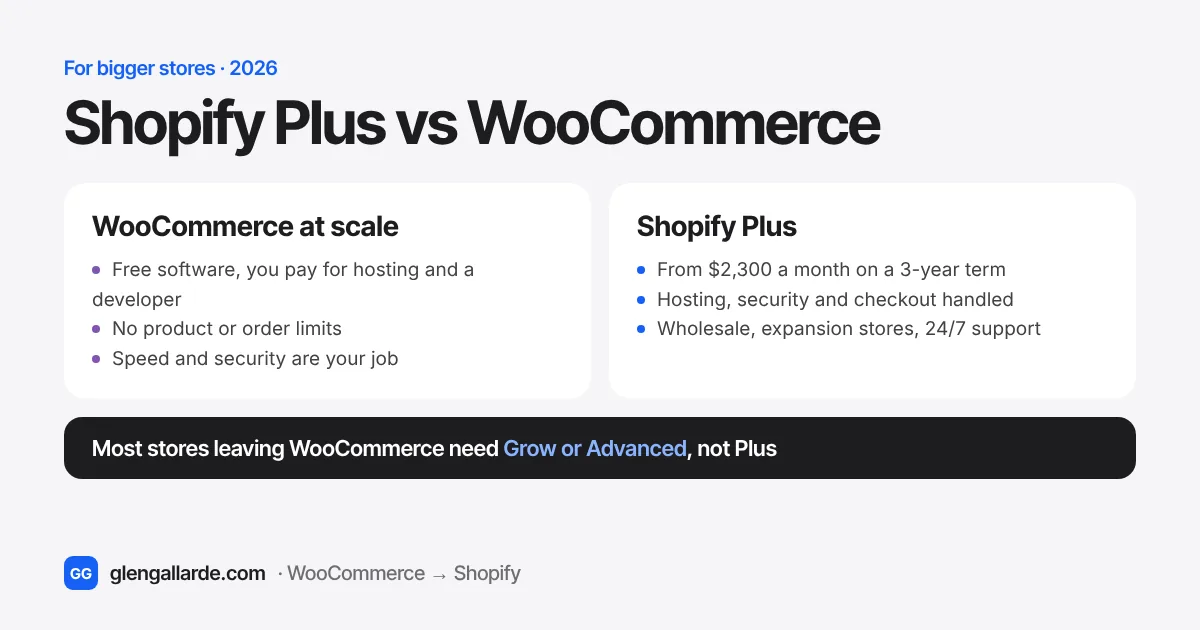
Most store owners who ask me about Shopify Plus don't need it. They've outgrown cheap WooCommerce hosting, they're tired of plugin updates breaking the checkout, and "Plus" sounds like the serious option for a serious store. It's an understandable leap, and it's often a $20,000 a year mistake.
Other owners really do belong on Plus and spend years stuck on WooCommerce because the price scares them. So here's the honest version: what Plus costs, what a large WooCommerce store costs to run, what you only get on Plus, and the point where the numbers tip.
What Shopify Plus costs in 2026
Shopify lists Plus from $2,300 a month. That price is for a 3-year term. Plus is sold on 1-year or 3-year contracts, and recent quotes put the 1-year term at about $2,500 a month. There's no month-to-month option like the other plans have.
The flat fee isn't the whole story for big stores. Above a certain level of sales, Shopify charges a percentage of your sales instead of the flat fee. Shopify doesn't publish the exact numbers. Industry guides put it between 0.25% and 0.40% of sales once you pass somewhere around $800,000 a month. If you're near that level, ask for the variable fee and its cap in writing before you sign.
On top of the platform fee you still pay card fees. With Shopify Payments, Plus gets the lowest published US rates:
| Fee | Shopify Plus | Advanced, for comparison |
|---|---|---|
| Platform fee | From $2,300 a month (3-year term) | $399 a month, or $299 paid yearly |
| Online card rate, US | 2.25% + 30¢ | 2.5% + 30¢ |
| In-person card rate | 2.3% + 10¢ | 2.4% + 10¢ |
| Extra fee if you use another payment provider | 0.2% | 0.6% |
| Contract | 1 or 3 years | Monthly or yearly |
US prices and rates from shopify.com on 6 November 2026. The 1-year price and variable fee come from published quotes and guides, not from Shopify's site.
Apps cost the same on Plus as on any other plan. Big stores usually run more of them, and some app makers charge more for Plus stores, so budget a few hundred dollars a month. The full Shopify pricing guide covers the other plans and every fee in detail.
What a big WooCommerce store really costs
WooCommerce itself is free at any size. That's true, and it's also the line that makes WooCommerce look cheaper than it is for a big store. Once you're doing real volume, the costs move from a licence to people and servers:
- Hosting that survives a sale. A $20 shared plan won't hold up to a Black Friday email. Proper managed WooCommerce hosting or your own cloud server, with object caching and a CDN, usually runs from a couple of hundred dollars a month to well over a thousand for the busiest stores.
- A developer on call. Someone has to apply updates, test them first, fix what breaks, and look after speed. Whether that's a retainer or an in-house person, it's the biggest line on most large WooCommerce budgets.
- Security and PCI. On WooCommerce, keeping the site patched is your responsibility. That includes WordPress, every plugin and the PHP version underneath. A hacked checkout is expensive in more ways than one. This year's PHP vulnerability is a good example of what lands on the store owner.
- Premium plugins. Subscriptions, wholesale pricing, advanced search and ERP connections are mostly paid plugins with yearly renewals.
Add it up for a store doing a few hundred thousand dollars a month and WooCommerce often costs about the same as Plus, sometimes more. The difference is where the money goes. On WooCommerce you're paying people to keep the platform running. On Plus, Shopify does that part, and your developer works on the store itself.
Shopify Plus vs WooCommerce, side by side
| WooCommerce | Shopify Plus | |
|---|---|---|
| Software cost | Free | From $2,300 a month |
| Hosting | You choose and pay for it | Included, no traffic limits |
| Updates and security | Your job, or your developer's | Shopify's job |
| Products and variants | No hard limits; speed depends on hosting | No product limit; up to 2,048 variants and 3 options per product |
| Checkout changes | Anything, if you can code it | Apps and extensions inside every checkout step |
| Wholesale (B2B) | Plugins | Built in, with unlimited price lists |
| Several stores or regions | Separate sites or multisite | Up to 9 extra stores included |
| Staff accounts | Unlimited | Unlimited |
| Support | Your host and your developer | Priority 24/7 phone support |
| Payment providers | Any, no platform fee | Any, but 0.2% extra unless you use Shopify Payments |
What you only get on Plus
This is the part that matters, because Shopify has moved a lot of former Plus features down to the cheaper plans. Shopify Flow, the automation tool, is on every plan now. Since April 2026, the regular plans also get basic wholesale features: company profiles, payment terms, volume pricing and up to three price catalogues. So "we need wholesale" no longer means "we need Plus" on its own.
Here's what is still Plus-only, and worth paying for if you actually use it:
- Serious wholesale. Unlimited catalogues for customer-specific pricing, catalogues assigned straight to a company or location, deposits and partial payments. If you have dozens of trade accounts on their own price lists, this is the big one.
- Checkout customisation. On Plus you can add custom fields, upsells, banners and logic inside the information, shipping and payment steps, and build your own discount and shipping rules as private apps. The other plans can only use public apps for most of this, and get far less room in the checkout itself.
- Expansion stores. Up to 9 extra stores at no extra platform cost, handy for separate regions, a wholesale-only store or a second brand.
- More locations and more API room. Up to 200 inventory locations and up to 10 times the API limits on some APIs, which matters when an ERP or warehouse system is syncing all day.
- Launchpad and priority support. Scheduled sales that change prices, themes and products at a set time, then switch back. Plus 24/7 priority phone support.
One thing that has changed for anyone researching old Plus guides: Shopify Scripts are gone. They stopped running on 30 June 2026 and were replaced by Shopify Functions. If an agency pitches you Plus for "custom Scripts", that pitch is out of date.
When does Plus pay for itself?
Owners often justify Plus by its lower card rate. Let's check that against Advanced. Plus saves 0.25% on US online card payments (2.25% against 2.5%) and costs $1,901 more a month than Advanced billed monthly.
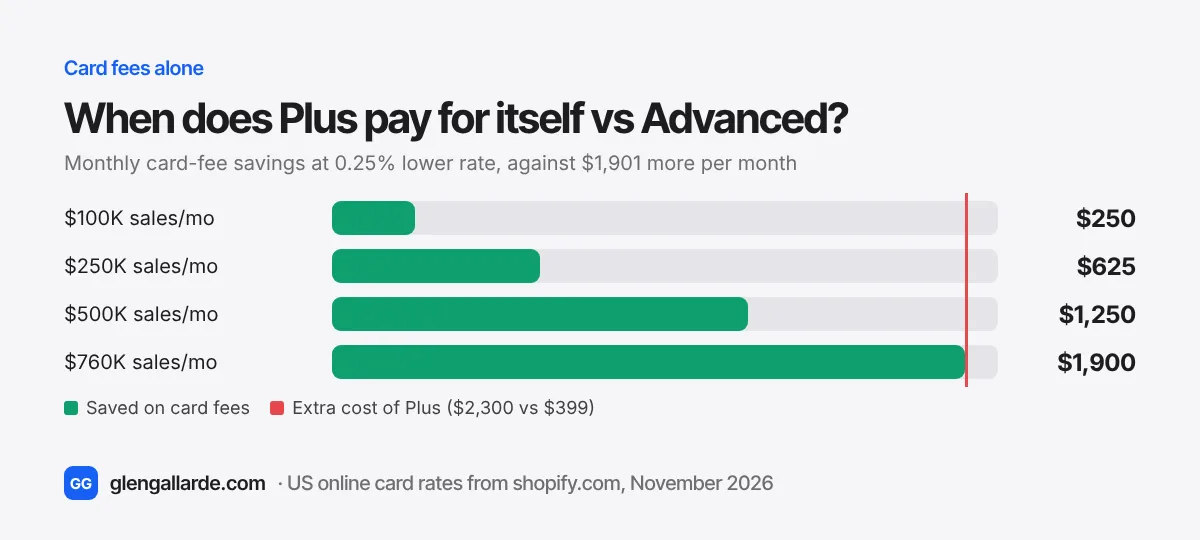
So on fees alone, Plus doesn't break even until you're selling around $760,000 a month online, or about $800,000 against Advanced paid yearly. Very few stores buy Plus for that reason, and you shouldn't either.
Plus pays for itself when one of its features earns or saves real money. For example, a checkout upsell that lifts your average order, a wholesale channel you couldn't run otherwise, or a second store for another country instead of a second platform bill. If you can't name the feature and roughly what it's worth to you, stay on Advanced. Moving up to Plus later is a sales call and a contract, not a migration.
Can WooCommerce handle 50,000 products?
Yes. WooCommerce doesn't cap products or orders, and stores with tens of thousands of products run on it every day. Turn on High-Performance Order Storage, which WooCommerce has made the default for new stores since version 8.2. It moves orders into their own database tables and helps a lot once you have years of order history.
The catch is that at that size WooCommerce is only as fast as your hosting and your plugins. Search, filters and the admin product list are usually the first things to slow down. Fixing them is real work: object caching, a proper search service, cleaning up plugins and tuning the database. It's doable, but it never really ends.
On Shopify, any plan handles 50,000 products and big traffic spikes. You don't need Plus for that. The limits to know are per product: up to 2,048 variants and 3 options, such as size, colour and material. A WooCommerce product with a fourth attribute needs restructuring before the move.
Who should pick what
| Your store | My recommendation |
|---|---|
| Under about $100,000 a month, mostly retail | Shopify Grow or Advanced. Plus would be most of your platform budget for features you won't use |
| $100,000 to $500,000 a month, a few trade customers | Advanced, using the built-in wholesale features. Revisit Plus when wholesale outgrows three catalogues |
| Many trade accounts on their own price lists, deposits or net terms | Plus |
| Several brands or country stores to run from one place | Plus, for the expansion stores |
| Checkout logic that drives revenue, such as complex upsells or custom fields | Plus |
| Heavily custom store with a good developer you already pay | Staying on WooCommerce can be right, if the site is fast and secure and you like owning it |
| Around $800,000 a month or more | Plus, but negotiate the variable fee and its cap before signing |
Not sure what your current WooCommerce setup costs against Shopify? The WooCommerce vs Shopify cost calculator works it out from your own numbers in about a minute.
Moving a large WooCommerce store to Shopify Plus
The move itself works the same as on any plan. What changes with size is the care needed:
- Start on a regular plan while you build. You can build and test on a development or trial store and sign the Plus contract when you're ready to launch, so you're not paying $2,300 a month for a store nobody can buy from yet.
- Map every URL. A big store has thousands of product, category and blog URLs with years of Google history behind them. Every one needs a 301 redirect. The redirect guide explains the patterns, and the free redirect generator builds the file.
- Import in order and in batches. Products, then customers, then orders. Turn off staff order notifications first. The migration tools guide compares the apps that do the heavy lifting.
- Rebuild integrations, don't just reconnect them. ERP, warehouse and accounting connections are usually the longest part of a big migration. Shopify's API limits and webhooks work differently from WooCommerce's.
- Tell your customers about sign-in. Shopify customer accounts use a one-time email code, not a password, so nobody has to reset anything. A short email on launch day avoids a pile of support tickets. See what happens to customer passwords.
Questions
How much does Shopify Plus cost per month?
From $2,300 a month on a 3-year term, and about $2,500 a month on a 1-year term. Stores with very high sales pay a percentage of sales instead, which Shopify sets per contract. Card fees and apps come on top.
Is Shopify Plus worth it over WooCommerce?
It is if you'd use a Plus-only feature, such as large-scale wholesale, checkout customisation or several stores, or if you're spending as much on WooCommerce hosting and developers as Plus would cost. If you just want a faster, simpler store, Shopify's Grow or Advanced plans give you that for far less.
Can WooCommerce handle 50,000 products?
Yes. WooCommerce has no product limit. With good hosting, object caching, High-Performance Order Storage and a proper search tool, large catalogues run well. Without them, search, filters and the admin get slow first.
What is the difference between Shopify Advanced and Shopify Plus?
Advanced costs $399 a month. Plus starts at $2,300 and adds unlimited wholesale catalogues, deposits and partial payments, checkout customisation inside every step, up to 9 extra stores, 200 locations, higher API limits, Launchpad and priority 24/7 support. Plus also has slightly lower card rates.
Do I need Shopify Plus for wholesale?
Not always. Since April 2026 every Shopify plan includes company profiles, payment terms, volume pricing and up to three wholesale catalogues. You need Plus for unlimited customer-specific price lists, catalogues assigned to specific companies or locations, deposits and partial payments.
Can I move from WooCommerce straight to Shopify Plus?
Yes. The migration is the same as for any Shopify plan. Most large stores build and test on a regular plan or trial and switch to the Plus contract at launch.
Sources
- Shopify Plus pricing (starting price, card rates, third-party fee, expansion stores, locations, support; 6 November 2026)
- Shopify pricing (Advanced plan price and rates)
- Shopify changelog, Key B2B features now available on non-Plus plans (2 April 2026)
- Shopify developer changelog, The product variant limit is now 2048 for all merchants
- Amp, How much does Shopify Plus cost (1-year and 3-year term prices, variable fee ranges)